Articles
Ours are based on techniques that we’ve scientifically tested while growing hundreds of clients in almost every type of business. (To see more than 109 case studies, visit our “Clients and Results” page.)
A lot of readers tell us they have doubled their sales by following the advice in the following articles.
Get our latest articles by email—plus a free copy of our bestselling book, Making Websites Win
Making Websites Win is an Amazon #1 bestseller in 15 categories. A goldmine of the best conversion advice, it has been recommended by Google, Facebook, Microsoft, Moz, Econsultancy, and many more industry leaders.
Right now, it’s available for purchase, in paperback, hardcover, and Kindle. However, as our gift to you, it’s yours for FREE, when you subscribe to our incredibly useful newsletter.
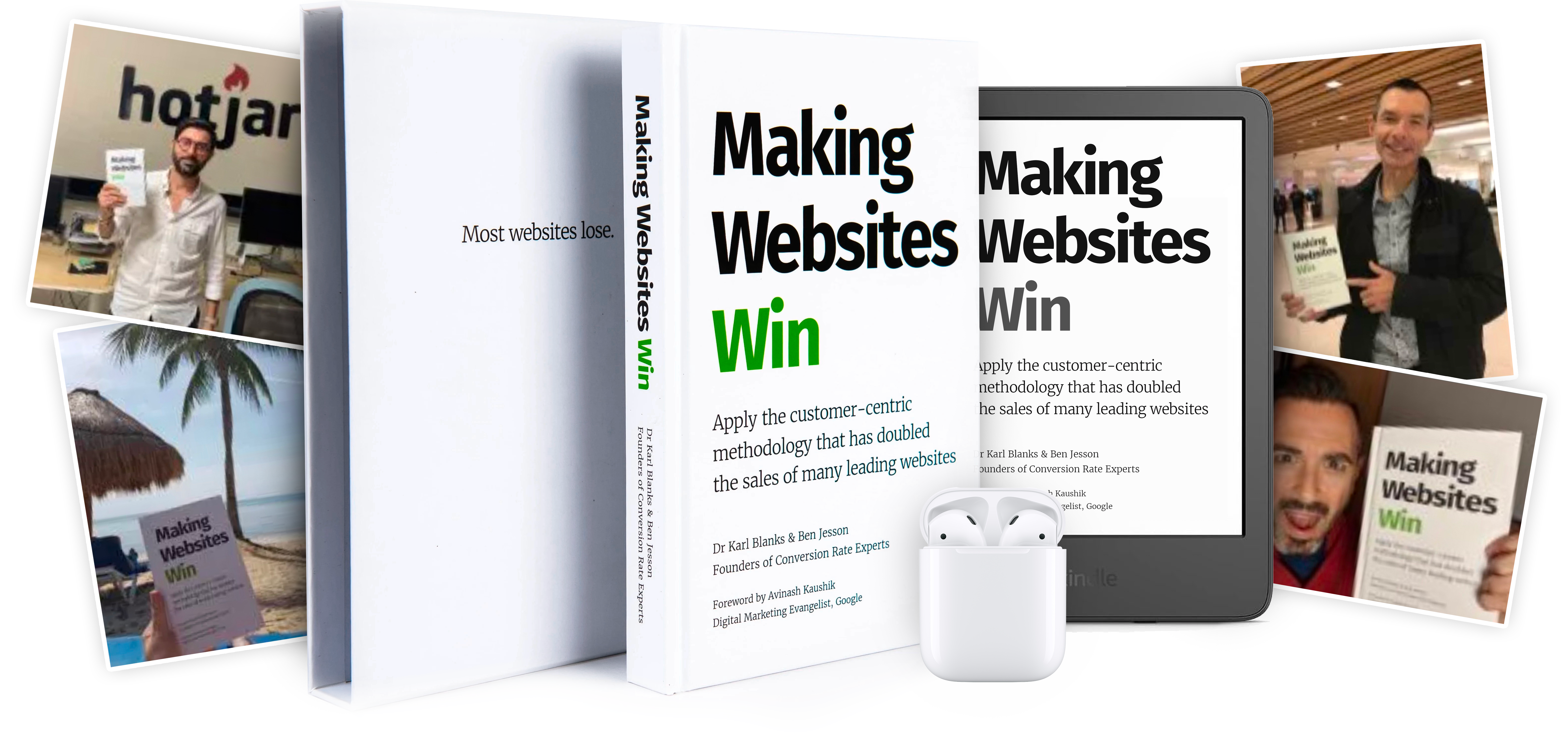
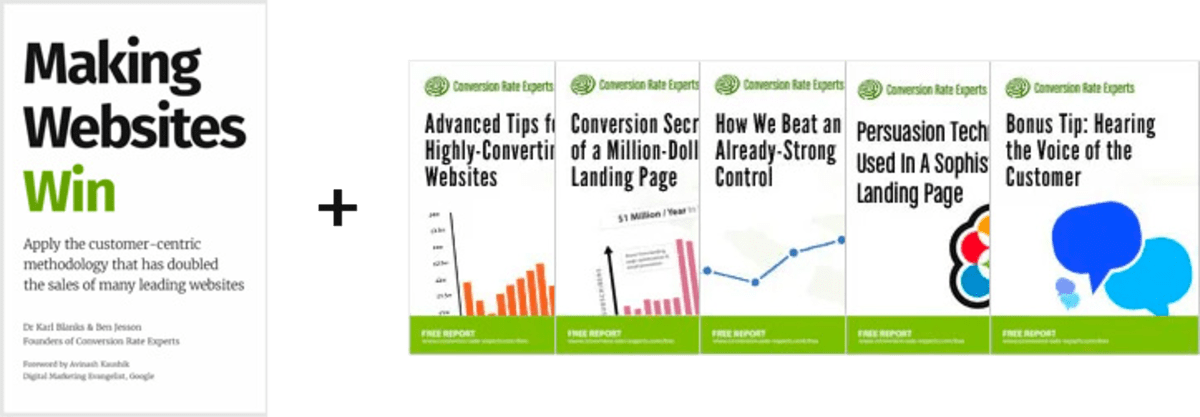
Subscribe below to instantly download the entire book—all 354 pages—in your preferred format. Plus, the bonus resources.
Articles
- Win Report: How a simpler homepage increased sales by 24%
- Copywriting Friday: What Don Draper knew about copy
- Introducing CRO for Amazon Sellers: Turn more shoppers into buyers and outsell your competitors
- Win Report: How we increased orders by 9% without a discount code
- Copywriting Friday: Why you're worth it
- Win Report: How rewriting one button increased sign-ups by 39%
- The Amazon CRO playbook: How to optimize your listings and beat your competitors
- Introducing our second book: The 2027 CEO’s and Founder’s Pocket Guide to Growth
- Resources for The 2027 CEO’s and Founder’s Pocket Guide to Growth
- Thanks for attending our talk
- Copywriting Friday: The best ads don’t create desire, they borrow it
- Win Report: How closing a gap with competitors increased Churnet Valley Railway’s ticket sales by 10%
- Win Report: How supply-side CRO lifted sign-ups by 15%
- Copywriting Friday: Dumb Ways to Die
- Win Report: Why adding an extra step to a funnel increased order value by 28%
- Copywriting Friday: How Old Spice made itself new
- Win Report: How showing a team member increased leads by 79%
- Win Report: Less funnel, 26% more revenue
- Copywriting Friday: Steve Jobs launches the iPhone
- Case Study: How a website redesign delivered the best year ever for Churnet Valley Railway
- Use the steel man technique to persuade people who disagree with you
- Win Report: How one change was worth millions more for a major airline
- Copywriting Friday: How to sell something ordinary
- Win Report: +39% conversions by removing a prominent call-to-action
- Copywriting Friday: What Al Pacino can teach you about copy
- Win Report: How reversing the funnel increased orders by 22%
- Where to spend your AI budget? Google has just given you the answer
- Copywriting Friday: If I bought a car
- Win Report: How button microcopy increased sales by 29%
- Tips and tools: Our new favorite podcast, the software that shaped the world, and a test that stumps AI
- Win Report: How a homepage redesign won by 25%
- Win Report: How resolving pricing page doubt increased conversions by 8%
- Copywriting Friday: A Mac walks into a room
- Win Report: Are you selling what your customers are buying? (+26%)
- Copywriting Friday: How to compete when you can't outshine the giants
- Win Report: Less cognitive load, 41% more conversions
- What to do when your organic traffic drops (and how to recover lost growth)
- Copywriting Friday: Five techniques from Amazon’s relentlessly tested product pages
- Win Report: How answering one question increased conversions by 18%
- Copywriting Friday: How to outmaneuver competitors without raising your voice
- How to get bigger, quicker wins by optimizing your testing workflow
- Win Report: How a simple “what next?” section increased conversions from blog traffic by 43%—and how you can do the same
- Win Report: A product title change that increased conversions by 23%
- Copywriting Friday: One of the few things on the Space Shuttle that didn’t have a backup system
- Win Report: One word, 38% more bookings
- Win Report: How reusing winning copy increased conversions by 82%
- Growth for seasonal businesses: How CRO helps you win when it matters most
- Copywriting Friday: The hard way and the Apple way
- Win Report: How an ingenious use of CTAs increased conversions by 57%
- Tips and tools: The risks of redesigns, the power of simple words, and an unseen Steve Jobs interview
- Win Report: How reassuring sports fans increased conversions by 29%
- Win Report: How an appeal to emotion doubled conversions
- Win Report: How reframing lead times increased conversions by 22%
- Win Report: How removing friction increased paid subscriptions by 13%
- How the world’s best companies build unbeatable focus
- Win Report: Six words, seven percent more leads
- The Safe Step Principle: Why “Buy now” hurts conversions
- Win Report: Ask for less, get (28%) more
- The ROAS equation that explains why top advertisers can outbid everyone else
- Tips and tools: IKEA's time machine, Ford's fake quote, and testing products across 50 years
- Copywriting Friday: Succeeding in a Darn Tough business
- A case study in redesigning navigation
- Tips and tools: Costco’s Kirkland play, CIA elicitation tricks, and what it’s like to be someone else
- Win Report: How contextual messaging increased paid subscribers by 9%
- Copywriting Friday: Does the world need another cookbook? (Yes.)
- The Infinite Manager: An exercise to make you rethink how you manage projects
- Win Report: How nine words increased conversions by 14%
- Copywriting Friday: For sports fans who know everything
- Win Report: Less hero, more party (and 5% more sign-ups)
- Win Report: Remember me? How saved sessions increased conversions by 16%
- Win Report: When user behavior surprises you, pay attention
- Copywriting Friday: How to march to a different drummer—and sell a lot of drums
- Win Report: How trust signals turned suspicion into 16% more signups
- Win Report: How simplifying a modal increased transactions by 13%
- Win Report: Why adding one button increased sales by 30%
- Win Report: Less clutter, 17% more transactions
- Copywriting Friday: A masterclass in attention and credibility
- Win Report: 13% increase in sales with a simple change to a product page
- Win Report: When a lever works, pull it again
- Low-traffic, high-value: A CRO case study on Millbank FX
- Win Report: How future pacing doubled demos for a SaaS company
- Triple R: A technique to accelerate your progress
- The invisible ceiling that limits SaaS and subscription businesses (and how to smash through it)
- Why writing and editing is more important (and profitable) than ever
- Copywriting Friday: Working hard vs. hardly working
- Win Report: How the Ovsiankina effect grew leads by 53%
- A guide to unstoppable growth for CEOs and founders: The hidden math behind CRO
- The Private Equity Strategy for growing profits without increasing budgets
- Win Report: A year’s worth of PPC leads in just three weeks
- The power of product demonstrations: What we can learn from elevators, elephants, and vacuum cleaners
- How to get an unfair advantage
- Win Report: Improving the sign-up experience for millions of users for a leading AI SaaS company
- Copywriting Friday: Breaking rules for fun and profit
- Duplication is evil
- Five interesting conversion mistakes we’ve made and seen
- The math behind PPC dominance: a data‑driven study of “The Power Law of CRO”
- Win Report: How streamlining a funnel for high-intent users boosted subscriptions by 18%
- Copywriting Friday: How to persuade skeptical people
- Switching Sales: How to get prospects to switch to your product or service
- Win Report: How highlighting a simple quiz boosted subscriptions by 34%
- The ultimate guide to proof: Highly effective ways to boost your company’s credibility (and sales)
- Copywriting Friday: Are you one of us?
- Why DiPS (Diagnose → Problem → Solution) thrashes meek tweaking
- Why the biggest opportunities often look like toys
- What Lemmings can teach us about CRO
- Win Report: How usability improvements to a product page grew conversions by 23%
- How much are you overspending on paid advertising?
- How to turbocharge your golf game (and your copywriting)
- How to win at Lifetime Customer Value (LCV)
- Win Report: How a simplified sign-up flow increased conversions by 12%
- All you need is a slight edge
- Why our clients become CRO experts
- Why CRO is hard for startups and low‑traffic websites (and how to overcome it)
- Better call CRO: Why Breaking Bad’s Saul Goodman is a conversion rate genius
- Read All About It! Seven timeless persuasion elements you can use today
- A template to help you design unbeatable multi-step conversion funnels
- Win Report: How becoming the customer helped us increase conversions by 26%
- Which side of the table are you on? Three ways to earn your customers’ trust
- User testing: Learn the techniques we use to make millions for our clients
- Copywriting Friday: Do you make these mistakes in job interviews?
- Ancient Persuaders: Four types of stories that sell without sounding salesy
- Win Report: How simplifying a homepage boosted sign-ups by 9%
- Before you can persuade your visitors, you need to persuade your team
- Win Report: How research-inspired bullets grew conversions by 12%
- Copywriting Friday: A tale of four pizzas
- How to tell if your expensive new website is useless
- Win Report: How improving first impressions increased conversions by 19%
- Copywriting Friday: The Sales Prevention Department
- Win Report: Learn how streamlining subscriptions increased sales by 18%
- Four ways to improve your copywriting vocabulary
- Five golden questions that reveal exactly why your visitors aren’t converting
- Copywriting Friday: Your superhero salesperson
- Win Report: How reframing a choice boosted paid subscriptions by 19%
- Copywriting Friday: “Oh Yeah? Prove it!”
- Fighting subscription churn: Thirty-two tactics to increase your retention and get back to growth
- Copywriting Friday: Seven ways to make your testimonials work harder
- Win Report: How an optimized pricing page increased paid trials by 43%
- Copywriting Friday: Do not think about a zebra
- How to make users scroll down your page
- Tips and tools: Aldi’s legendary floor, fast fonts, and the psychology of IKEA
- Copywriting Friday: The personal touch
- Win Report: How a dynamic tagline increased conversions by 15% for a worldwide media brand
- Win Report: New lead funnel increases SaaS demos by 58%
- What would definitely work, if only you were allowed to do it?
- Copywriting Friday: What part of France are you from?
- Win Report: How removing content increased conversions by 36%
- Three techniques to improve your value proposition
- Win Report: How “new” navigation increased sales by 32%
- Copywriting Friday: “Beware of any endeavor that requires new clothes”
- How to use gap analysis to gain an unfair advantage over your competitors
- Win Report: How Johnson Boxes boosted conversions by 20%
- How to get paid much more—your 7-step plan
- Win Report: How changing one image almost doubled conversions
- How to beat your competitors
- Copywriting Friday: “I amazed even myself!”
- Tips and tools: SaaS pricing models, Poor Charlie’s Almanac, and the lose-lose battle facing social media
- The 8 Wastes: How we optimize through subtraction (and how you can too)
- Copywriting Friday: It’s what you don’t know that hurts you
- Win Report: How a site-wide benefits bar increased transactions by 8% for a German shipping platform
- Tips and tools: Why freemium can fail, how a young designer “handled” Steve Jobs, and farewell Charlie Munger
- Win Report: How research rescued a website rebrand
- How the 80/20 rule can grow your business (like it has ours)
- Win Report: How a “sticky” call to action increased sales by 25%
- Win Report: How four bullets increased subscriptions by 39%
- Win Report: How blurring the results doubled sign-ups for a utility comparison website
- Tips and tools: Why Airbnb’s CEO values method marketing, how to persuade people who disagree with you, and a bird that sings like a chainsaw
- The Theory of Constraints: How we relentlessly improve our productivity
- Tips and tools: 900 days of progress, MrBeast’s success, and Seinfeld’s joke‑writing advice (for copywriters)
- How to increase your profits when selling commodities (and almost everything else)
- Tips and tools: Why you should fail a test on purpose, reframe your thinking, and stop speaking nonsense
- “Genchi Genbutsu” is the most powerful technique we know
- Tips and tools: Apple’s advice on writing, Monzo’s disruptive tone, and the reason we (obsessively) study success
- 33 ways your website can compete with Amazon
- Why it’s bad advice to “describe benefits, not features”
- Tips and tools: 10,000ft views of behavioral science, business KPIs, and cognitive bias
- Tips and tools: Digging deeper into primal needs, artificial intelligence, and why your speed of learning matters
- Bruce Springsteen and the critical question to ask before choosing A/B testing software
- Introducing Conversion Rate Experts’ new CEO and CTO!
- The best online marketing books and resources (that all our team members study)
- Nineteen tips for digesting books rapidly
- How to boost your profits by creating irresistible offers
- How to hugely increase your profits by optimizing your pricing
- The fastest way to understand users: talk to a “VOC Aggregator”
- How Apple brilliantly used a 100‑year‑old persuasion strategy
- Your success graph
- Do you know someone who works for a charity? Or do you support a cause that’s dear to your heart?
- Loads of useful articles that weren’t in our book
- 90 tips for “lockdown working”
- A roundup of the best accessibility resources (now a legal requirement)
- Tips and tools: DIY sentiment analysis; 102 design-thinking tools; and how to improve autofill for forms
- Buffet delegation: A low-risk way to delegate difficult work
- The page we send to all our new clients, to improve their success
- Conversion Rate Experts has joined the Next 15 group (see the new ways we can now help you grow)
- “The Power Law of CRO”—and why it means CRO is the most important activity for your business
- Psychological barriers that stop you from adapting
- How to find opportunities to be valuable right now (a 7-step process)
- Answers to your hardest remote-working challenges
- How to quickly write pages to increase sales
- Selling remotely: A proven 11-step workflow to grow your business with remote sales calls and webinars
- The Infinite Manager: How flows can eliminate work, so you only have to think once
- Should you apply your CRO skills to a wider area of influence?
- Tips and tools: the world’s fastest projects; 3X your speed with kaizen; and how to use heatmaps
- If you take lots of screenshots on a Mac, you’ll love these little-known tips
- Tips and tools: A website accelerator; MailChimp tips; scanning documents; and a logo test
- Tips and tools: Realistic mockups; email templates; full-page screenshots on mobile; and more
- Tips and tools: Optimize your forms; understand machine learning; become a Google Sheets ninja; and more
- Tips and tools: Easy conversion calculators; DIY videos; and horrendous panoramic dogs
- The Infinite Manager: Everyday examples that lead to “Genchi Genbutsu breakthroughs” in productivity
- The Infinite Manager: How we manage our personal flows
- The Infinite Manager: Flow Management—our secret to managing overwhelming volumes of work
- The Infinite Manager: How to run a highly efficient remote company
- Tips and tools: Create awesome forms; make an app from a Google Sheet; become great at drawing; and more…
- Tips and tools: How to go viral; create voice apps without coding; learn typography in ten minutes; and more…
- Free podcast of our entire book, Making Websites Win
- For the second time, the Queen has given us the UK’s highest official award for business
- Thank you for helping to feed 2,518 children
- Several ways to get a sample of our best-selling book (or the full hardcover at a discounted price)
- How to write better by upgrading your computer monitor
- Tips and tools: An easy way to send direct mail; Google tools for WordPress; and more…
- We’ve won several awards for our industry-leading culture
- Tips and tools: When persuasion backfires; video messaging; and more
- Tips and tools: How to edit any website; tutorials for non-developers; Mac’s new screenshot feature; and more
- Tips and tools: A chat-based tool to convert visitors; designing for voice; A/B testing videos; and more
- Tips and tools: Easy personalization; how to get product–market fit; The Queen; and some great resources
- What makes a great front-end developer?
- Tips and tools: An update and some great resources
- Tips and tools: How to optimize your profile photo—and other great resources we discovered recently
- The best of 2017
- How to make your writing easier to read (and increase your sales)
- How to find fantastic service providers (like accountants, lawyers, doctors…and tiger trainers)
- Get the company handbooks of the world’s most sophisticated businesses
- Tips and tools: 189 mental models for success (and other great tips)
- Tips and tools: How to become insanely well connected—and other great resources
- The ultimate blueprint for rapid growth
- Why Moz’s Rand Fishkin calls CRO “the most important marketing activity”
- Tips and tools: 42 pricing tactics; apps to make explainer videos; why the best people are underrated; and a tired meerkat
- Tips and tools: How to write great sentences; Jeff Bezos’s 2017 letter; a funny book; and the best programming books
- Tips and tools: Funny user interfaces; Amazon soon to be half of all e-commerce; and a genius guide to content creation
- The ultimate cheat sheet of cognitive biases
- John Cleese’s advice on how to be creative—and how to apply it to conversion
- Jerry Seinfeld’s advice for joke-writing—and how to apply it to copywriting
- Tips and tools: Eye tricks, data visualization, how to start a business, and more
- We’ve won the UK’s highest official award for business—from The Queen at Buckingham Palace
- The Handover of Death: What to do if parts of your sales funnel are outside of your control (and are terrible)
- Grow your sales by creating urgency—featuring examples of scarcity from Booking.com and Garth Brooks
- How to make visitors come back
- 99 wireframe tools and prototyping resources
- 42 great usability-testing tools and resources
- Method marketing—and other ultra‑qualitative research techniques to increase your sales
- The best survey tools (and how to use them to grow your business)
- Understanding your customers and visitors using analytics
- Tips and tools: The best of 2016
- How we got a 157% increase for one of the world’s leading digital marketing teams
- Tools for UX and CRO: The Ultimate Guide
- Tips and tools: Google’s new A/B‑testing tool, the best sales books, learn CSS in 12 minutes, and more
- Tips and tools: 42 tools for onboarding users, 10 tips for customer referrals, how to get enterprises to buy from you, and more
- How we make the world’s best mobile websites even better
- How Dropbox does A/B-testing
- A rare insight into Amazon’s experimental culture
- This week, measurable marketing went mainstream … and the advertising industry is in shock
- How Mike Lee went from zero … to half a billion dollars
- Optimizing for user value: How we helped to grow a crowdsourced learning platform
- Conversion for mobile: how we helped grow a FinTech company by 470%
- The answer to this one question is proven to hugely grow your sales
- An entrepreneur who bootstrapped his company to award-winning profits
- A portable laptop stand we love
- How to sell complex products and services (Part 3)
- How to sell complex products and services (Part 2)
- How to sell complex products and services (Part 1)
- How we more-than-doubled the leads for a SaaS company (with images of the winning pages)
- Why some of your projects take ten times too long (and what to do about it)
- How we evaluate marketing software
- Tips and tools: Including an amazing sales pitch from Elon Musk
- How to do guarantees right. And how we grew a business by 49% by adding a guarantee.
- How to eliminate the usability problems that stifle your growth
- Does CRO mess up SEO? And vice versa?
- Conversion mistakes we’ve made. And how conversion affects SEO. With Rand Fishkin from Moz.
- Conversion Killers: The Definitive Guide
- Meek tweaking (and blindly applying best practices)
- Secret copywriting words and why we don’t do Twitter
- Tips and tools: 15 great resources for growing businesses
- Tips and tools: 162 lean tools and principles for making your company less dysfunctional—plus some other fantastic resources
- We have designed pages for more top-500 websites than any other company. Here’s why they are winning.
- How we try to get an accurate view of the culture in our remote-working business
- Tips and tools: Resources we’ve discovered recently (Sep 25, 2013)
- How to make millions from usability testing
- A fun game that helps you to acquire Bill Gates’s “10-year” skill
- Your “skunkworks” stories and some useful conversion tips
- Tips and tools: Resources we’ve discovered recently (Apr 2, 2013)
- Tips and tools: Some little-known tools and techniques we’ve used to grow our own business
- Tips and tools: Resources we’ve discovered recently (Mar 15, 2013)
- Tips and tools: Resources we’ve discovered recently (Feb 27, 2013)
- Tips and tools: Resources we’ve discovered recently (Feb 11, 2013)
- Card sorting, and two tools for doing it
- Ecommerce conversion optimization: Two winning tests for a multilingual online florist
- Does optimization ever end? How we grew Crazy Egg’s conversion rate by 363%
- How we helped a client become the fifth-fastest-growing company in the UK
- A couple of things we have published elsewhere
- Less is more: how we used Crazy Egg to boost our own conversions
- Habits of a highly successful web team: an interview with one of the UK’s fastest-growing web businesses
- Boomerang for Gmail helps you keep track of your projects
- Infographic: Nine steps to better conversions
- What’s the best software for critiquing webpages?
- Q&A: How sunshine.co.uk overcame the recession and doubled sales in six months
- How we doubled the sales of a web app (includes a useful PDF)
- How we made an extra £14 million a year for a travel company
- Qualaroo (formerly known as KISSinsights): a free conversion tool you MUST use
- How we made $1 million for Moz (formerly SEOmoz)—using landing page optimization and email marketing
- At last, a comparison of A/B- and split-testing software
- The following webinar has already happened…
- How we increased the conversion rate of Voices.com by over 400%
- What is multivariate testing?
- Google’s prediction: What will be the “sexy” job in the next ten years?
- A handy tool for capturing ideas from your customers: UserVoice
- Is your graphic design helping or hurting your business?
- A/B testing 101: A quick-start guide to conversion rate optimization (CRO)
- Introducing the Conversion Rate Experts blog
What’s your goal today?
1. Hire us to grow your company
We’ve generated hundreds of millions for our clients, using our unique CRE Methodology™. To discover how we can help grow your business:
- Read our case studies, client success stories, and video testimonials.
- Learn about us, and our unique values, beliefs and quirks.
- Visit our “Services” page to see the process by which we assess whether we’re a good fit for each other.
- Schedule your FREE website strategy session with one of our renowned experts.
Schedule your FREE strategy session
2. Learn how to do conversion
Download a free copy of our Amazon #1 best-selling book, Making Websites Win, recommended by Google, Facebook, Microsoft, Moz, Econsultancy, and many more industry leaders. You’ll also be subscribed to our email newsletter and notified whenever we publish new articles or have something interesting to share.
Browse hundreds of articles, containing an amazing number of useful tools and techniques. Many readers tell us they have doubled their sales by following the advice in these articles.
Download a free copy of our best-selling book
3. Join our team
If you want to join our team—or discover why our team members love working with us—then see our “Careers” page.
4. Contact us
We help businesses worldwide, so get in touch!
© 2026 Conversion Rate Experts Limited. All rights reserved.
A Brandwidth Group Company.