feedback

How Apple is brilliantly using a 100-year-old persuasion strategy

1 Star2 Stars3 Stars4 Stars5 Stars (rated 4.72 by 57 people)
Loading ... Loading ...

Full disclosure: This article was written before we engaged with Apple as a client, so it isn’t influenced or informed by our relationship with them.

How do you persuade your prospects of the quality of your product? Use this strategy: Show the work that went into creating the product.

This can take two forms:

1. Show the work that went into inventing the product

2. Show the work that goes into creating each individual product.

For example, if you were selling Rolex watches, you could tell the story of how the watch was designed, or you could describe the painstaking process by which each individual watch is manufactured. Or you could do both.

How this technique was used to sell beer 100 years ago

The advertising legend Claude Hopkins used this strategy to revolutionize the sales of Schlitz beer in the early 1900s. He did so simply by being the first to describe how beer was made. He toured Schlitz’s operations and noted down all the aspects of their process that he found interesting. In particular, he highlighted those that supported Schlitz’s main claim: that their beer was pure. The campaign was a huge success. Within a few months, Schlitz went from fifth place to being joint-first in the market.

Even if you’ve heard the story before, you probably haven’t seen any of Hopkins’ ads. Here’s one of them:
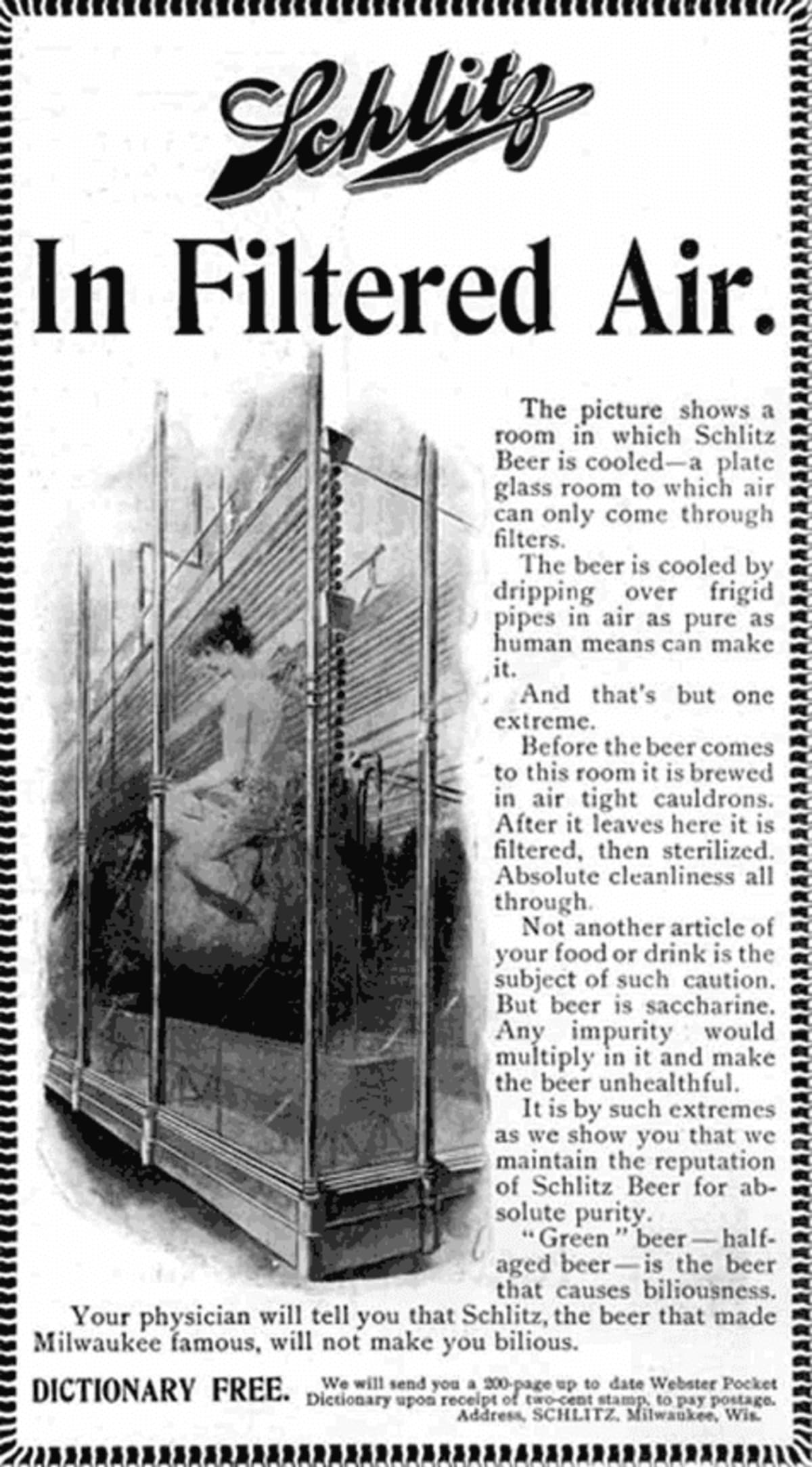
Apparently, the techniques he describes in the ad were common to many beers; Hopkins was simply the first to mention them, thereby implying that the techniques were unique to Schlitz.

How Apple is using this technique to sell laptops

Hopkins’ ads now look comically out of date, but the technique is still as fresh as a daisy. Here’s a fantastic modern-day equivalent—the following video shows the work that went into creating the body of Apple’s new MacBook Pro laptop:

(You only need to watch the first three minutes of the video.)

If you’re too busy to watch it—and we recommend you do—here’s what happens: Apple’s Senior Vice President of Design passionately describes, and shows, how the body of each MacBook Pro laptop is carved from a single block of metal. According to Apple, this increases the reliability and robustness of the laptop, and allows it to be lighter and smaller. It’s a brilliantly persuasive piece of marketing.

Unlike in the Schlitz example, Apple’s manufacturing techniques do appear to be unique to Apple, which makes the video even more effective.

At Conversion Rate Experts, we have had great success with this technique, having incorporated it into winning webpages for clients in weight loss, B2B products and health supplements, and achieving conversion improvements of 67%, 101% and 114%, respectively.

Why does it work?

This strategy works for several reasons:

1. It adds credibility to your claims. When you describe the work that went into creating a product, you are providing supporting evidence for the product’s features. Many breweries were claiming that their beer was pure, but Schlitz was the first to give justification as to why its beer was pure.

2. It is concrete. People struggle to think in terms of abstract concepts. “Pure” is a vague abstract concept, whereas “beer being dripped over frigid pipes in a plate-glass room” is concrete.

3. It tells a story. People respond well to stories. Stories can be considered to be the “native programming language” of the human brain.

4. It gives you something new to say. In some mature markets, it’s hard to think of anything new that can be said about a product.

5. It gives you something to say when the product’s benefits or features are not easily discernible. If you’re selling bottled water or luxury watches, it’s hard for the prospect to discern the benefits—and the benefits themselves aren’t even particularly interesting. The background story can be the most compelling aspect of the product. This leads us to…

6. It can give “romance” to the product. People love to associate objects with romantic pasts. For example, which guitar player would not like to play Jimi Hendrix’s guitar? Don’t underestimate the power of romance in your copy, particularly if you’re selling something that doesn’t have many logical benefits.

So, how can you use this strategy?

  • List the main benefits of your product.
  • Presumably, you go to extreme lengths to create these benefits. Would your prospects be impressed if they could see the work that went into creating the product or service?
  • Remember, you are likely to underestimate your own achievements. Even if a technique is commonplace, it may still be impressive to your prospects.
  • Bring your process to life. Tell the story. Feature the people who worked on it—and show the passion behind it.
  • Be highly specific: Lexus is smart to say its Certified Pre-Owned cars go through a “rigorous 161-point checklist,” rather than just saying “a rigorous screening process”.

When will this strategy not work?

Clearly, this strategy will only work to support a particular claim. If Apple’s prospects didn’t care about quality and elegance, the video would have no effect on their behavior. If a particular prospect was a PC user, and their main objection was that they didn’t want to learn a new operating system, the video would not affect conversion.

Do you have other great examples of this strategy?

If you know of any inspirational examples of how this strategy has been used, please add them to the comments fields below.

P.S. If you didn’t read this article out loud, you missed out on saying the word “Schlitz’s”.

1 Star2 Stars3 Stars4 Stars5 Stars (rated 4.72 by 57 people)
Loading ... Loading …

Comments

  1. DrJ says:

    Great post as always, golf putter manufacturers have been doing this for the past few years. Putters as you know are a bit lacking in technology compared to e.g. drivers but Scotty Cameron does a great job of showing why his putters are so good (expensive), see making the Studio select or even Bettinardi putters.

  2. Great article guys. In most cases, the more flesh you can add to the story and the more concrete evidence you can provide to back up your claims the better.

    Re: the beer example, the German Beer Purity Law is something pub bores reel off to me on a regular basis whenever the topic comes up. I suspect brewers from other countries probably have similar processes / practices, but they don’t have the benefit of such a tangible piece of evidence to hang their claims on.

  3. virtuoso says:

    Great stuff!

  4. I can apply this to my service which is representation of people injured in accidents. I can take a few key items from our checklists and elaborate on them to describe the steps we go through in performing the service.

  5. Paolo says:

    Thanks for sharing these powerful insights.

    I would like to ask you if you believe this technique will work as well for intangible products and services such as: training programs, coaching sessions, public speaking, E-learning webinars. If with intangible services the persuasion approach should be different, please elaborate. Thanks! Great Work!

  6. It’s funny you mentioned Rolex because they had a series of these videos that went into the painstaking work of creating each watch.

    It took me a while to find, but here they are on Ted.com. It’s an awesome series of videos even if you’re not into watches.

  7. Adam says:

    Great article! I read two of Claude Hopkins books in the past 3-4 weeks so it was very timely to read this post.

    It would be great to see some examples of this strategy being applied to services as well as products.

    I find that blogs and newsletters are great at this kind of process explanation, however, I think that most of the time, people don’t write blog posts with this line of thinking or strategy in mind.

    If anyone has service related examples, I would love to see them.

  8. Dayne Shuda says:

    I love this article.

    The concept is great for each of the six reasons you mention.

    I hadn’t really thought about this conversion strategy a whole lot and I’m always arguing with myself over whether explaining benefits in long-form like this works better than using short-form.

    It seems customers are willing to take the time to read or watch longer content if it explains the process of how products are made.

    I don’t think LL Bean is using it to promote their boot, but I found this video on You Tube showing the production process.

    The story of having 90 of 100 or the original boots returned is timeless for how customers view LL Bean’s customer service.

    PS – I have to admit I’m partial to this article simply due to the fact that I love that Schlitz went back to the original recipe. Delicious. :-)

  9. Jackson says:

    Interesting article… unfortunately, the Apple “love affair” is actually getting to the point in the relationship where one side is starting to act obsessive and over-dramatizes every little thing, while the other side is getting tired of it and is looking to “turn off” the relationship.

    Not saying the marketing method they’re using isn’t brilliant… but it can backfire, as not everyone is a simpleton rube for Apple’s pitch… the history of Microsoft (vs Google) and AOL illustrate the point exactly.

    Customers fall out of love (and turn to hate) just as quickly as they fell into it… can you say OBAMA? ; )

  10. aoleon says:

    A fantastic article. And it explains why I have always been a Mac user… the proof is in how you make the pudding.

  11. Dan says:

    Great Post! Are you able to make public the name of clients you successfully used this technique with, or show the ads? Thanks

  12. Nice to see the Schlitz example, which is referred to quite often in modern advertising days, into todays high-tech environment. Looking forward to what you come up with next.

  13. James Carter says:

    Great post as always guys! Many good points here. We’re running into some challenges with market perceptions that one of our client’s products we sell online is not durable enough, we’ve done Youtube videos of people beating the heck out of it. I don’t think this client can afford to play Coldplay music in the background but perhaps going into engineering & build details is the answer.

    Thanks!

  14. Great article. Apple seems to have quite a few “case studies” on how well they execute(d) various marketing initiatives. Are you guys by chance working with them? :-)

  15. Andy says:

    Great article. I enjoy the timeless Schlitz example. Thanks for all the great material.

  16. Chris says:

    This is great, certainly something I’ll incorporate into my ‘pitch’.

    On another note, I used Kampyle recently with great success – so thanks for making me aware of it!

    I discovered that the most compelling copy was my ‘about us’ page – two people said it influenced them to actually purchase. Like you mention above, it’s a simple story, but for some reason, effective.

    The result was to take the ‘about us’ page content and pop it on the home page. It had an immediate effect on lifting conversions!

    Thanks guys,

    CT

  17. nancy says:

    I see how this subject relates to my business completely. We are mostly a service provider. We offer some services that many others do, but we compare our services to what you’d find at an upscale store rather than a big box discount store. In another way, we are quite unique in what we offer. I can see putting together a video of how we consult with our customer for the service and go all the way through to carrying out the service and posting the video on both our website and YouTube.

    Great ideas. I’m a PC user, but found the idea of looking at the new MacBook something I’d like to do.

  18. “Presumably, you go to extreme lengths to create these benefits” & “you are likely to underestimate your own achievements”

    This happens sooo often. Business owners takes things for granted. Just because they work day in day out with a certain material or equipment makes them think it is nothing special, but for people who are new to it or come from an other profession, their work looks like magic.

    Thanks for pointing out these things and please provide more of these useful blog posts.

  19. kristian says:

    Nice article. Another example is the VW Phaeton. They have a factory with glass walls made just for this car; the factory has become the showroom and customers (or curious people) can come and see their car be assembled.

    BTW: “manufacturing techniques do appear to be unique to Apple” – its called CNC milling and have existed since 1940, Apple are just smart and make it appear as it is something new (its only new in computer case manufacturing).

  20. Prosini says:

    As usual guys, you’re just amazing, I just need more posts on your blog ;-)

  21. Josh says:

    McDonald’s did this in a catchy way in the jingle they created for the Big Mac in the ’70′s “Two all beef patties, special sauce, lettuce, cheese, pickles, onions on a sesame seed bun.” There was nothing particularly unique about the burger, other than having a piece of bread in the middle of it, but they got everyone talking about it with the jingle explaining what it’s made of and forever staked the claim on that tactic in the fast food world.

  22. Heike says:

    Awesome video.

    Great blog, thanks a lot for this info.

    Rgds Heike

  23. Excellent post.

    You are absolutely right. This technique makes one want to buy the product.

    I’m a big fan of the Thinkpads (Lenovo/IBM), but my next notebook could well be from Apple. I at least check it out. Just not sure how good Apple support is outside of the USA.

  24. Brendon Gearin says:

    The same process has been used for decades for high ticket items. Ferrari does it all the time. I remember seeing it when i was 10.

    Still waiting for mine…

    Cheers

    Brendon

  25. My first visit, brilliant post, really.

    Thx and regards

  26. So the next time you’re depressed and down on yourself, remember all the work your mother put in just to get you born :) I love the part when I went from 8 to 16 cells the best, personally.

    Seriously, each of us has the potential for unique contribution, fueled by expertise and passion and consistent effort. When we can articulate, not how great we are, but how much we care about what we’re doing and how much we care about doing it well, that’s just contagious.

    Well discussed ad (thanks for finding and reprinting) and video.

  27. They also use this strategy quite often in the food industry; showing you where the food comes from, how it was grown, taken care of, only the best selected etc.

  28. That’s very interesting. Apparently it’s working for them since they’ve been so successful lately.

  29. Arvind says:

    Excellent post… found it very interesting… very handy approach too. Kudos to you for the post.

  30. I wish more advertisers would show how their product is made. Seriously, are those workers in Bangladesh paid enough to support their families? Is the toxic waste disposed of properly? Will I get sick from the factory raised beef?

    I might buy your product, but I won’t become a raging fan while I still have these dark suspicions in the back of my mind.

  31. This is a great post. It make sense that people like to see the painstaking effort you have done to make your products. But there are problems with causality here.

    1. Every advertiser who does this is not successful. Something else is going on. I make towers of peanuts as a hobby (an example only, pardon me!) and I can keep describing how much effort I spend and still people wont buy it. Artists in general are all of this category-they will often show you with their own lives how much effort they put into producing whatever they produce, but most of them die poor anyway. Something else is going on-more than slick marketing and telling stories and features and benefits of your products and the painstaking process.

    2. The Schliz Beer guys often stop there-where is this beer now??? That these things are TEMPORAL, shows again that it is a mistake to attribute Schlitz’s jump in sales to this ad campaign alone (it may be a factor, but how much?). If it was so good why is it not No. 1 beer today???

    Marketing people are liable to fall in love with their own stories..but the economic world of buyers and sellers is not as simple as that.

    Sanjay

  32. Hi Sanjay. You’re right, no advertising technique can sell a product that no one wants. But techniques such as this can help to grow an already successful business, as we’re seeing every day with our clients. The simple re-wording of a page can create an immediate increase in sales—and scientific split tests allow us to demonstrate that the improvements weren’t due to extraneous factors.

    You suggested that it’s a mistake to attribute Schlitz’s jump in sales to this ad campaign alone.
    Of course, it’s impossible to know all of the factors that might have influenced Schlitz’s sales that year, but Claude Hopkins was a pioneer of trackable advertising—which he outlined in his book Scientific Advertising—so he’s as reliable a source as any.

    So why is Schlitz not number one today? This comes down to the “many factors” you mentioned. With time, what was once a winning edge can become an industry standard. Companies need to keep developing and innovating. Fortunately, readers of this blog have an advantage, because they are among the few that track the results of their actions, so they only keep what works, and discard tests that don’t.

  33. Nice post! very useful.

  34. Chris Warren says:

    Great post…you make it sound so easy.

  35. Great Article. This really explains the strategy well!

  36. Rishi says:

    Great post and this is an amazing strategy. Thank you for writing about it.

    Samuel Adams (the beer company) does this in their ads. Each one of their commercials talks about how much work they put into each beer.

  37. Spinal Pro says:

    This is a great strategy. Many people know the quality of Apple products because they know that a lot of work went into them. Great article by the way! I really enjoyed it.

  38. Joe says:

    This is definitely a very powerful method to pull people into your brand and products.

    The folks over at Field Notes use this method very effectively. See their behind-the-scenes video of how they make their product:
    http://fieldnotesbrand.com/2011/05/09/introducing-the-steno/

  39. Paul says:

    Hi there, I just came in thru a seomoz suggestion…and I’m glad to tell the post is really great. Concentrating on the marketing basics and trying to re-adapt them to our days is at least a guarantee of high success rate, kind of solid. I love the creativity behind this particular strategy, lot to learn of :)

  40. As a recent convert to the ideas of internet marketing, seo and conversion and in a business sector, Bathroom Installation, which is not exactly as glamorous as some others especially Apple it is always difficult to try and differentiate and find hooks to engage with visitors.

    I signed up for your newsletter and come back here everytime there is a new post as there is always something to make you think and something to take away that can be applied in a practical way. This one is no different and I can see how I could use some of the suggestions.

    Keep up the good work and I look forward to the next one!

  41. Scop says:

    Qualifying a brand. amazing read.

  42. Gail O says:

    I understand the concept here but if you are selling 400 different gifts, should you put this amount of work into the store history, the categories or the individual products? For the best return on your efforts, which would you attack first?

  43. Ray Edwards says:

    Shows how selling is selling is selling. Human nature hasn’t changed and the old “scientific” principles still hold today. Great article and example.

  44. Some things never change. I find it interesting that a selling tactic that worked over a hundred years ago is still valid today. Just goes to show, human nature never changes.

  45. This whole beer story reminds me of an “Open Doors” manifest of a local beer company. It’s the same principle i think.

  46. This is a great article and a great perspective. But I also love how you’ve used it repeatedly in your marketing (for over 2 years!) . Looks like the first comment was Sept 2009, and I received a mention of it in an email two days ago. Brilliant!

  47. Satchel says:

    Great points. And very easily appliable to any business who manufactures a product. This is the age of storytelling. The better you tell the consumer your story, the better your CR will be. Clearly explaining how something is made is a great example. Thanks!

Speak Your Mind

(Required)